Lumines Arise review - cor, this is wonderful
Snow-Balls have flown their Arcs.
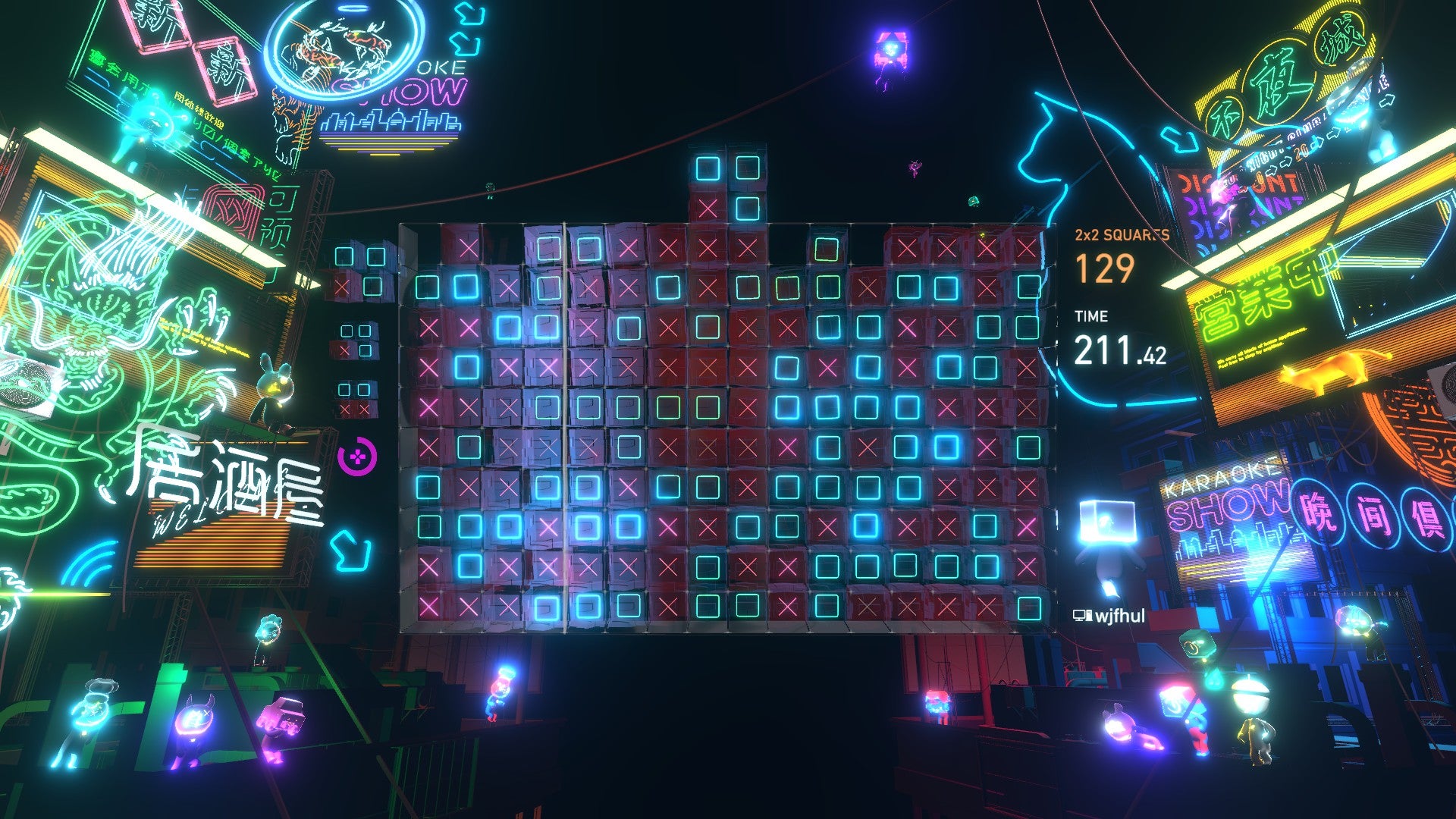

Confusing things, video games. I've always thought that Tetris is the ultimate game: the game we'll all still be playing when the sun explodes. And yet, at the same time, I've also thought that there are better puzzle games out there. Well, there's one better puzzle game at least.
This is because Tetris just gets faster and faster until I can't play anymore. It may be the ultimate video game, it may be my favourite video game, the standard bearer for planet earth, but I'm strictly middling as a Tetris player. And that's the thing: at a certain speed, quite a lot of people become middling at Tetris. Tetris speeds up until it boots you out.
Enter Lumines. Lumines is another falling block game, but rather than getting faster and faster, it regularly changes the speed and the tempo. It modifies the texture of the challenge in surprisingly consequential ways. So sometimes it's faster and sometimes it's slower, and being slower doesn't necessarily make it easier, because now maybe your blocks are clearing more slowly, so your play area is filling up faster.
Then along came Tetris Effect. Tetris Effect basically made Tetris a bit more like Lumines: rather than faster, faster, dead, you had faster, slower, ooh, interesting. Slower, again, could be easier or harder depending on the variables. Crucially, slower or faster was always different. Here was a Tetris with biorhythms that were ceaselessly changing. Here was a Tetris that was always ready to intrigue and infuriate and delight.

Now. If you're still following me, here is Lumines Arise, which is basically Tetris Effect for Lumines. It's a wonderful game. Let's get that out of the way now. I will be playing this for the rest of the year, so if you have any urgent messages for me, write them on a piece of paper and tear the paper into little pieces and throw them in the air because I am very busy sorting blocks. But Lumines Arise can't benefit from the main lessons of Tetris Effect because it already knows them. And so this glorious game makes ever-so slightly less of an impact than Tetris Effect. We're talking microns or other similarly tiny divisions, but still. And why? Lumines' peculiar challenge is that there was less to fix.
Anyway! Enough maudlin stuff. Cast aside the trappings and suits of woe, because even if there was nothing to fix, cor, this is wonderful stuff. Jump in.
A quick recap for any lucky people out there who have yet to experience Lumines. Blocks will fall, and they will be 2x2 squares, merrily, and then sometimes oppressively, dropping in different arrangements of two colours. The job of the day is to sort the colours into their own blocks of 2x2 squares in order to clear them from the play area and earn points.

Fine. But there is more. Because the play area is horizontal: a movie screen rather than the chill buried chamber of a well. And every few seconds a timeline sweeps across, left to right, and it's this timeline that clears any blocks you have successfully sorted into colours.
Fine. But there is yet more. Before the timeline sweeps, you can grow those blocks of colour by adding more blocks of the same colour to them. Multipliers! Fine. But the whole thing is also musical, with each fall of a block, each turn of a block this way and that adding to the growing sonic landscape, evolving the tune, expanding the leitmotif, conjuring bridges and tumbling, euphoric middle-eights.

That's Lumines. Allow scrambled colours to build up and reach the top of the screen and it's game over. Play brilliantly, though, and you'll cycle through different stages, where the colours of the blocks change, the musical elements change, and the evolving visuals that flock and scatter behind the whole things change. Testify!
Right. So Lumines Rise takes all that and it just amps it a little. Actually, it amps it quite a lot. Sonically, there are bangers here, but there are also fascinating stages where stray creaks and scrapes and coughs come together to build into something unprecedented. (The soundtrack is by Hydelic and Takako Ishida, who worked on Tetris Effect: Connected.)
Visually the blocks change colour, but they also transform. One moment they're little PlayStation Xs and Os encased in glossy, hardboiled candy shells. Then they're speckled hen's eggs and feathers, or they're a polite selection of legumes. One of my favourite levels offers escapements and watch faces, another conjures black holes that may or may not contain an astronaut.
Onwards. The world around the blocks is transformed in playful ways too. Previous Lumines levels have given us low-orbit disco satellites and dancing robots, but here we have a level of balls that roll towards the player or away from the player when blocks are cleared. We have at least one level slopping with water, where blocks placed to the left or right of the play-space will tilt the whole thing. We have a camera that is alive to the multipliers, for each score's fine chances for glory, zooming in, lurching forward in staggers and then retreating, disappointed when you've properly biffed it.

Add to this a proper mechanical change up. Lumines has always been geologically minded, with fuse blocks that allow you to touch off dynamite chains of same-coloured squares, collapsing the ground in stages. But Arise chucks in Bursts, its equivalent for Tetris Effect's Zone mode, in which you could stack cleared lined up into the giddy dozens.
Bursts is fascinating. A meter builds up during standard play and can then be cashed in for moments in which falling blocks will now add to a great growing mass of same-coloured block somewhere in the playing field. Grow that block and see the points go up. Build it to knock away blocks of the wrong colour, to change its shape, to see it spreading across the game's enchanted movie screen. Meanwhile, the timeline transforms the mass and tells you how many more times it will sweep past before Burst is over. And once Burst is over you cash in your points and clear all the same-coloured blocks you've just grown. At which point, all the other blocks, the neglected colours, fall back from the ceiling and you get another cascading wave of multipliers.
Burst is wonderful. Unlike Zone, which always reminded me that I was playing wrong, that here was a gift I had managed to squander, it's quite easy to get something good out of Burst. What's harder is understanding how to get something more than merely good. What is the right time to trigger burst? How many combos should already be forming on the playing area, and do you have to wait until you're at MAX burst, or will a sneaky 70 percent effort pay off? I love Lumines because you're always learning. Here is something new to learn.


Beyond the main mode, which, like Tetris Effect, unfolds in groups of stages that all come with a score at the end, you have the playlist and the endless mode, which is where the game will largely live for me once those stages have been properly learned. There's multiplayer in the form of a burst battle that sends garbage blocks to your enemy, and there are various score attack leaderboard chasers, involving one, which I love, in which you have to fight against a rising tide of blocks without being overwhelmed.
Then there are challenges, and these are essentially the Lumines Variations. One of them - I absolutely hate it - has you using combos to break open an egg in a certain space of time, which means you need to manage your space and find a place for all the colour jumbles that aren't going to help you. Another has you working around strange Lumines templates that carve up the screen. Another has blocks of different shapes and sizes dropping. There is a good month's worth of fun to be had working through all this stuff, and then cashing in the points you get to upgrade your little in-game avatar.
I am probably forgetting something, neglecting something, not giving something its due. But that's Lumines. These games have always come with oddities, but the central mode is so staggeringly joyous and compelling that it draws my eye and my attention and leaves me powerless to do anything else. Unlike Tetris, Lumines didn't need a borrowing from Lumines to become even better. All it needs - and this may just be me, and I know we have the Steam Deck - is a release on Switch 2, where that glorious panoramic screen that you hold in your hands is waiting to take this absolute dazzler back home to its portable origins.
A copy of Lumines Arise was provided for this review by Enhance.
