Kirby Air Riders review
Rollin'. Patrollin'. Ridin' Kirby.
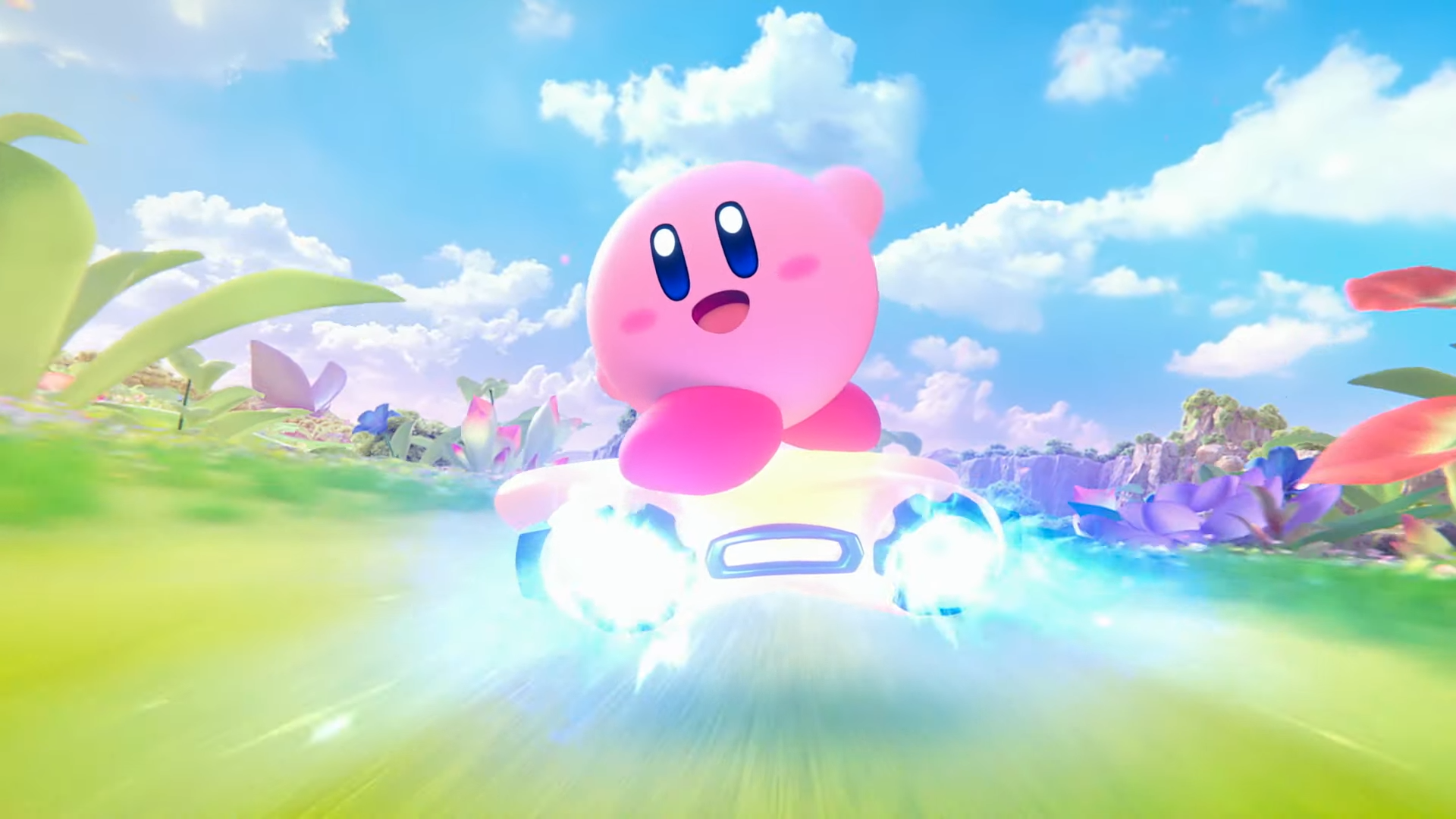

I now sort of understand why Kirby Air Riders was deemed worthy of a pair of Nintendo Directs that add up to a feature-length running time. Part of that is obviously the verbose design-nerd predilections of its director, Masahiro Sakurai, sure. But another reason is quite simple: this is a rather difficult game to describe.
In a sense, Kirby Air Riders relishes in being a joyous contradiction. It's difficult to explain while also being simple in execution. It has such easy-to-understand one-button gameplay that a very small child could manage, but it has depth that will please the most hardcore fiends out there. It also sort of defies traditional genre barriers, even if it is, at heart, a 'racing' game. That's the genre I'd name if someone held me to ransom and demanded I put it into as neat a classification as possible, sure.
And yet… to call Kirby Air Riders just a 'racer' is also a disservice. Yes, the primary action you undertake is to 'race'. But this is in fact a bizarre genre mash-up. Here in the midst of Kirby's light-hearted, one-button, kid-friendly racer beats the ferocious heart of a fighter, the multiplayer shenanigans of a party game, and even the pray-to-god luck of a roguelike. It's bizarre. It's also a little bit brilliant.

The most obvious comparison to make is, perhaps unsurprisingly, to Super Smash Bros. This is the series for which Air Riders director Sakurai is best-known - and from the minute you first boot Air Riders, with it popping up a little Smash-like 'milestone' achievement marking the fact you've booted the game for the first time, you can sense Smash's DNA.
The entire vibe is Smash, top-to-bottom. From the visual style to the deep level of customisation. The menu layout to its joyously peppy music. Of course, there's an excitable voiceover bloke that screams out at the start and end of races and mini games and the like. But it goes beyond the superficial: all of the things about Smash's very meticulous and particular design that makes it special are also present here. There's that same attention to detail, and same glee at just damn fine game design in itself.

If you take in the main menu of Air Riders, there's essentially four different modes to consider. Air Ride is probably what you most envision based on the game's top-line pitch: a simple kart racer where you pick a stage, character, and vehicle before duking it out against AI opponents or other humans via online or split-screen, no strings attached.
Then there's City Trial, a bonkers battle royale where players are dropped onto a shared map. You've got a limited amount of time to race about gathering resources from said map while also sabotaging others from doing the same. The resources you gather tot up to upgrade your 'machine' - that is, the thing you race on - before a final showdown in the form of a mini-game. The thing is, vehicles can be upgraded across a variety of categories and you don't know what the mini-game at the end will be until said end - so the question is do you work to collect items to build a balanced machine, or go all-in on a specific stat and then hope the mini-game choice at the end favors you?
City Trial is a fascinating mode, perfect for party play. If you want to know about City Trial a little more in-depth, I'd recommend our preview from earlier in the year as it was the mode Nintendo most-prominently demoed pre-release. If we're keeping up the Smash comparisons, City Trial is akin to the fighter's most outlandish levels with items turned up high - pure chaos, where mechanics and systems can end up interacting in the sorts of funny and wild ways that'll result in scream-inducing multiplayer mayhem. It's strange, however, how minutes of frantic preparation is then resolved in an often very-short mini game. City Trial is a riot, but its finales often feel anticlimactic.
I actually loved Top Ride, the third mode, the most. This again is playable by a group of people, and is basically the same as Air Ride mode but with a twist: it's played from a top-down perspective that, to me at least, resembles the old-school 2D Micro Machines games of the nineties. This was a formula for multiplayer joy then, and it still is now. Curiously, it's in Top Ride that I think you can see the creators of Kirby Air Riders most fiercely flexing their game-design muscles with a clear understanding that sometimes less is more.

Which isn't to say that there isn't a whole lot more. The oodles of things to do all come to a head in the fourth and final mode, Road Trip. This is the single-player mode of Kirby Air Riders, and it evokes a very unexpected game - Out Run! You compete in a series of stages that branch in an identical way to that classic, with said branches encouraging you to return and take on alternate routes.
Road Trip is tied together by a story that has inexplicably lavish pre-rendered cutscenes with an over-dramatic narrator, but really it is ultimately about bringing together all of the things built for the other modes. As you progress through each of the Road Trip stages you'll work through various challenges, and often be given a multiple-choice smattering of tasks to choose from. Those tasks could be Top Ride races, or Air Ride races, or any of the zany Mario Party via a racing game mini games from the conclusion stage of City Trial.
As much as I love the nostalgic-tickling mechanical purity of Top Ride, Road Trip is where I ended up sinking most of my time, and I imagine the same will be true for most players. For all the comparisons to Smash, this is the most competent single-player sort of offering I've seen from this kind of game from Sakurai. It's sort of the best of all worlds from him. The CG scenes and over-dramatic plot has shades of Brawl's Subspace Emissary. The simple way stages, races, and mini-games are strung together by a bit of casual continuity gameplay reminds me of Melee's adventure mode. And, of course, the core racing is quality enough because it has been made to stand strong alone, without all this single-player wrapping.
No matter what mode you gravitate towards, a steady stream of dopamine will be coming your way thanks to an absolutely enormous abundance of challenges, each with rewards that range from relatively inconsequential to game-changing unlocks of new racers (each of whom have different characteristics and special moves), machines (each of which have different stats), and stages. There's quite literally hundreds of these challenges hiding unlocks and collectibles, and you'll have to play the game for quite a while before you finish a race and don't unlock something. Again, if you've been playing Smash for any period of time, all of this will sound very familiar - and it sinks its claws just as deep here as there.

Like Smash, none of it would work if the core wasn't satisfying. I do think that the main single-button thrust of the game can be a little baffling, initially, and I totally expect a cohort of players to bounce off Air Riders as a direct result of that decision. It feels a bit too clever by half, in the sense that I don't actually think the game is particularly enhanced by the choice. With that said, it certainly works, and so having a grumble about that feels like a nitpick. What's astonishing is the level of depth and player agency that is injected into a game that, to a certain extent, can 'play itself' - albeit poorly - if left to its own devices.
That's where all those unlocks, upgrades, machines, riders and the like come in. There is immense strategy to be had here, which feeds back into the gratifying multiplayer experience on offer. There is just an absolute truck load to see and do, to the point where it's a little overwhelming, even. Kirby Air Riders presents as a fun and frivolous offering - but the breadth it has is anything but superficial. In fact, I find myself loving the mechanical depth so much that I wish I connected with the characters and courses more - but that feels dangerously close to wishing that everything Sakurai helms is a grand crossover, which is a sort of thinking that I fear could smother creativity.
Whether I've got it in me to chase down every one of the myriad unlocks remains to be seen, but what I am certain of is that this game will become a staple of my Switch 2 library for quick multiplayer shenanigans with friends. In that sense, it may indeed be even more like its sibling. In preview pitches, Nintendo representatives gleefully presented Air Riders as "Smash on Wheels". At the time, I pretty much rolled my eyes at this. But y'know what? Fair enough. It is the closest thing I've seen to Smash on Wheels - and that is a most compelling pitch.
A copy of Kirby Air Riders was provided for this review by Nintendo.
Read this next
- Super Smash Bros. creator Masahiro Sakurai seeks a "modest, unassuming life" to avoid becoming "the plaything of the internet"
- Kirby Air Riders gets second dedicated Nintendo Direct later this week
- Kirby Air Riders' grand Direct unveiling was classic Sakurai, as he jokes it's not another Mario Kart clone
