"This is not a phase that teenage boys go through" - legendary Xbox boss Peter Moore on how Microsoft made Xbox 360 "a cultural phenomenon"
Part 2: Why the Xbox 360 couldn't just be "a phase teenage boys went through."

Yesterday, we published part one of our interview with former Xbox 360 boss Peter Moore, where he talked about the creation of Microsoft's beloved machine, the grand idea encompassing it, and how his team had to break from the stuffy office-worker image Microsoft had. "Guys with pocket protectors and thick glasses", as he described it. He also talked about "throwing punches" to provoke the Xbox vs. PlayStation console war.
Today, in part two, Moore takes us further, up to the console's launch and to the games released for it, and to the unwanted side-effects of stoking that console war. He also recalls seeing that memorable Gears of War trailer for the first time, which he believes upended the industry's approach to marketing, and he tells me what Microsoft needed to do to convince Rockstar to put Grand Theft Auto on Xbox. We even touch on what he thinks of Xbox now.
A reminder that Moore has released an autobiography called Game Changer, which covers his career working in games, at Sega and Microsoft and EA, as well as his time as CEO of Liverpool Football Club and beyond. He's currently a minority owner of Polish football club Wisła Kraków, the owner of American football club Santa Barbara Sky FC, and an advisor to Welsh football club Wrexham AFC. He's also an advisor to mobile gaming company Reality Games and media studio Panga Entertainment Productions.
So, you're preparing to unveil the Xbox 360. How do you go about designing these reveal moments - what don't we see? There's years of work on the line here. You have to get the messaging right.
Peter Moore: This is where you build a roadmap. You bring in your comms team, your marketing team, your product marketing team, your manufacturing team, who will tell you what they're capable of delivering. You then work tirelessly to create a positioning that you feel A, you can live up to, B is different to the other guys. And you build culture internally.
I remember we needed to describe what we're doing, and what we described was we're building a living entertainment experience powered by human energy. That is a sentence I will never forget, and that summed up who we were. You need a manifesto. What are we doing here? We're building a living entertainment experience, not a piece of hardware, and it's powered by human energy. Well, what does that mean? Xbox Live. It's powered by the people. You're building community, not just consoles. And it sounds obvious now when we think of gaming today; it was not obvious then. And you've got to tie-in your retail group, because it was still very much discs being sold into retailers all over the world. All of that has to be all coming together on a night in November in 2005.
Then you reverse engineer it. How do we speak to the community in a different way, rather than just TV commercials and giving our retailers what we call market development funds or co-op? Well I'll tell you what we do: we go to the California desert, we find airplane hangars from whatever they were building in Cold War America, and we do this thing called Zero Hour, and we make it all about the gamer. And if you can get there, to Palmdale, California, and get in line that afternoon, we're going to open the hangar gates and this green glow is going to come out, and there's going to be 500 beanbags with 500 demo units playing all the games. And we'll feed you and we'll make sure that you're comfortable, and at midnight, Best Buy will roll in a truck and you can buy an Xbox 360. And that's what we did.
This was very much a very different take to a console launch, which is usually big and glitzy, and national if not international. This was as grassroots and gamer-first as you can get.
"So much that Microsoft does is an everyday part of our life, and I like to think a little bit of that was because of Xbox, as simple as that."
And if we jump forwards a bit, how are you assessing the actual launch? What things are you looking for to tell you if the Xbox 360 has been a success? Units sold, presumably?
Peter Moore: Well, in simple terms your sell-in is pretty much guaranteed. It's a bad sign if your console isn't sold out from your initial production quantity, because every retailer around the world wants a piece of it. Now, the sell-through as the months go on and as production gears up and all of a sudden you've got stock in the warehouse and it needs to sell through: that's important. But the simple criteria is: what did you sell-in? What do you sell through? What is your attach-rate of software to hardware - so how many games are you selling? Because that's where the money is. And in our case it's how many people are playing on Xbox Live - what games are sticky? How are we engaging our community? What are the new business models - whether it be downloadable content and micro-transactions, whatever it happened to be at that time - how are they doing?
And all of that comes together so you create what's known as KPIs, key performance indicators. Still in the early days, you're calling your retailers every other day saying what are the numbers? What's selling well? And of course, you're having almost daily conversations with your stakeholders, primarily the third-party publishers, as well as your first party - we owned a ton of studios obviously that were creating great content. And then you're watching, because now you can watch in real-time engagement through Xbox Live. You can see who's playing, how long they're playing, what are they playing, where are they playing, and bluntly, how much money they're spending if they put their credit card down.
It's all the things you put in place that are, I think, second nature now for the big first parties, for the Sonys and Microsofts of this world, and Nintendos. But in those days, particularly with Xbox Live coming into the fore, you're creating brand new KPIs, and the good news is you can look at them in real time and measure them in real time.

And is everyone happy at Microsoft with what they see? What do your bosses at Microsoft think about Xbox 360's performance - is everyone patting each other on the back?
Peter Moore: There's certainly no patting on the back. Look, in the early days, you better sell everything in. If you've got - let's make up numbers - half-a-million units on launch day, and it's a global launch, and you haven't sold it all in months earlier and then had secondary orders as production starts to flow through, either off containers on ships or air freight, then you've got a problem from the get-go. But there's no backslapping. It's a marathon, not a sprint.
And then you've got Christmas coming up, obviously. So then you want to make sure that it becomes the gift to have. And secondarily, you need to make sure that the right retailers have got the right amount of quantities, that they've got the programs in place that allow them to promote the Xbox 360. And a little bit then, you're also thinking about who's coming down the pike to you in March, and well, that would be the PlayStation 3.
So at what point do you or can you determine the Xbox 360 a success? Is there a moment in those early days-
Peter Moore: No. No. You've already planned day by day, week by week, month by month, what needs to be happening. What should be happening? What your numbers look like, what your attach rate looks like. You're constantly having conversations in those days with your retailers, your key retailers, your Walmarts, your Best Buys, your Targets - I'm talking US here. And you're talking and they're telling you what they're hearing, what they're seeing, what they're happy about, what they're not happy about.
What weren't they happy about?
Peter Moore: Well, if there's something they're not happy about - I didn't say there was anything they're not happy about. But retailers are never happy. They're not coming back to you with "this is amazing!" No, there's always something to moan about, I'm sure. You don't give me enough, or I need them here and you're a week late in shipping. All of those things. In those days, that's because your customer was retail. Fast forward a few years after, and then definitely a decade after, and your customer is you.
Sure, if retailers want to sell discs, great, but we made it very clear a little later on, and certainly in my EA days, that with high speed broadband with hard-drive memory expanding enormously, that we're going direct, and that changed the industry enormously. Instead of lining up for a disc at midnight, you waited for your pre-loaded game to go live at 12.01 am on Tuesday morning, and you can start playing because you pre-loaded it. Because you could, because your hard-drive was big enough and your broadband speed was fast enough.
Looking back on the games that came out during the Xbox 360 launch - Project Gotham Racing 3, Geometry Wars, Perfect Dark Zero, Condemned - and slightly beyond, do you think you got enough praise for delivering the spread of games you did?
Peter Moore: I don't know. And I don't care, because I knew what we needed to do. One of the things that we needed to make sure is we weren't just a shooter box. It's hard to understate the power of Halo during that period, and then of course Gears of War, which became the tip of the spear for the Unreal Engine 3. So you had Halo, you had Gears of War, and all of a sudden you're going, ehh [he winces], we don't want to be that box for 19-year-old boys.
For every Gears of War we needed a Kameo. We needed a Fable 2. Project Gotham Racing. In those days we're thinking: what is our Need for Speed or Gran Turismo killer? Forza - Forza would be that Gran Turismo competitor, so that was built internally, and PGR was the Need for Speedish thing. We even had our own sports titles, XSN Sports, which was kind of ill-fated and ill-thought out, because we should have just left EA to - and we did - do what they do well and support EA and EA Sports. But that was a legacy that went back to the old days, that if you're a first-party, you needed your own sports brand, and that doesn't exist any more. So from that perspective you're exactly right. The diversity... You talk about Geometry Wars, which was Bizarre Creations and just a few guys there in Liverpool trying to figure out 'this looks cool' and it became this cult hit. And a little later on, Viva Piñata - these cool, I guess you could call them quirky, but original intellectual property, which was key.
Now look, there'll never be a greater launch line-up than the Dreamcast, but I think the Xbox 360 line-up of original intellectual property, not just Call of Duty 5, 6, 7, 8, 9, 10, or Resident Evil 4, 5, 6, 7... You need those comfort IPs that people know what they're getting, but then you need stuff that's ground-breaking and genre-breaking, or genre-creating, and I think we did that well. And that was done by our amazing third-party group headed up by George Peckham, that knew years in advance what we needed to do. As well as our first-party team, Shane Kim and the team that oversaw that. You've got the benefit of obviously having Rare in that stable and figuring out what you could do internally that would complement and supplement what the third parties are.
This was the other thing: you've got your genres - tick, tick, tick, got it. You needed to make sure that you were not competing in your first-party development with the third parties. And the conversations were very much about placing our financial resources behind third-party publishers who were going to really tick a box for us in a particular genre.

Do you have any favourite Xbox 360 games? And were you actually playing games at the time - was there time for that as the leader of Xbox?
Peter Moore: Two games that I demoed ad nauseum for months on end - months on end - embargoed to the media, were Gears of War and Kameo. And if there's two games that couldn't be more opposite of each other in every element, it's Gears of War and Kameo. And it was important. I felt that Gears of War was going to be amazing from a visual perspective. Our friends at Epic had done tremendous work making this very unique IP that exists to this day, that would show off the power-
Gears of War did feel like a very next-gen moment.
Peter Moore: Totally. One of the things I'm very proud of as well is the TV commercial we did for Gears of War, which just put the entire industry on its head. Prior to that, it was all about how many explosions and what's your body count? How loud you can make your TV commercial to viscerally appeal to people. And all of a sudden, here's this poignant, sad, film noir of the Gears of War commercial.
I always remember our agency McCann Erickson came in, probably a year out, and came into a conference room and then said, we're going to switch off all the lights - a little awkward, bunch of guys there in the dark - and we want you to listen to this. And it was Gary Jules' version of Mad World, the Tears for Fears song, but done in a very unique way. I'm going: this is unlike anything I've ever seen or heard or imagined in a video game commercial.
And then we said we've got to do it in-engine so this is not going to be CGI, which a lot of stuff was in those days. No, we need to do it in-engine, otherwise how can we put our hands on our hearts and say this is what Xbox 360 is going to be if we don't? That was a lot more money and time consuming. But we did it in-engine. And that commercial, still, today, when you watch it, and every now and again I'd just send it to somebody who hadn't seen it - maybe even wasn't born when that commercial came out - and I'd say this was a visual asset for Xbox 360 that just changed the industry. And then you started to see a lot more emotional rather than visceral and violent things that tugged at the heartstrings a little bit.
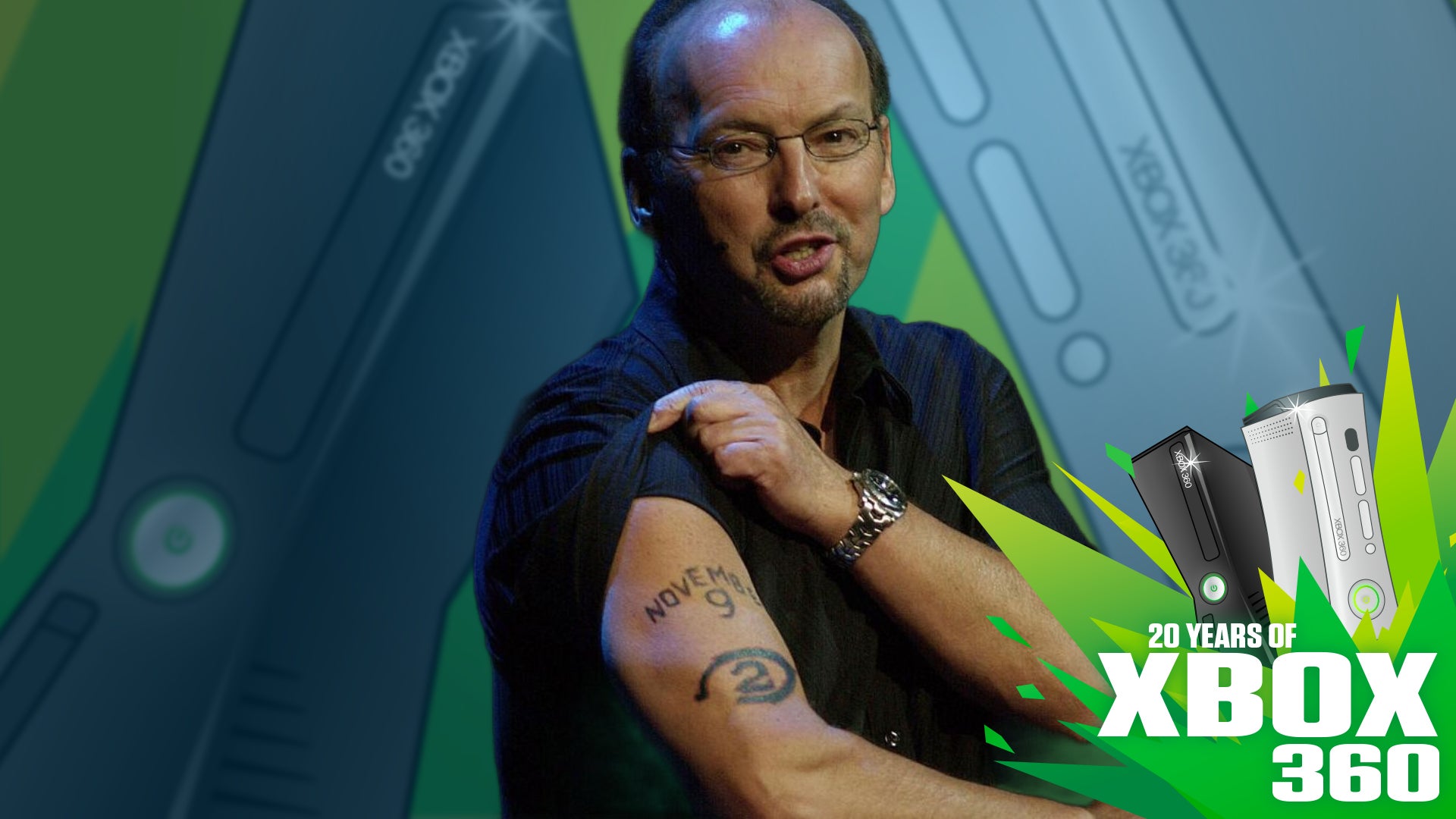
Were there any other major Xbox 360 moments like that? One I'm thinking of in particular is you on stage lifting up your shirt sleeve to show the world a GTA 4 tattoo. That felt like a big moment - Grand Theft Auto coming to Xbox.
Peter Moore: Certainly that was a big moment. If you weren't around in those days, the GTA franchise was a PlayStation exclusive. To their credit, PlayStation had bet on GTA 3 and from there on had done a deal and more credit to them. But we needed GTA. We needed that franchise and everything going forward from Rockstar on our platform. So we bet big on that and came to an agreement, and of course it needed a tattoo.
"You did things that were irreverent and daft and stupid, that maybe the movie folks and the music folks wouldn't do. But the demographic loved it."
Who brokered that GTA deal - was it you?
Peter Moore: It was our team, my team, and in particular people like George Peckham and account managers who just sit down [and ask] what is it going to take? What can we do that has a little bit of Xbox 360 exclusivity in there? Is there a map, is there something in there? Are there Easter eggs? And you would do all of that.
Was it just a question of money or did Rockstar need convincing in other ways?
Peter Moore: Well, money's important, but they needed convincing that their development resources, which needed to be shifted to Xbox SDKs, weren't going to be wasted if the console was going to be a flop. The worst thing you can do... There's an opportunity cost as well as a financial cost to putting a team to create a version for a specific platform or a console. And look, you can get paid all the money in the world to cover all your costs, but if it doesn't sell, that's an opportunity cost to the developer that they could have deployed on a console that would sell. And not only can they get the offset of the dev cost paid to them, but also the ongoing profits of selling software. So there's a combination of convincing and my team and I spent a lot of time on Broadway in New York City with the team there who believed in us, to their credit - that team there, Take-Two and Rockstar, joined us and believed in us, and it all worked out for all of us.
And at what point does someone - you, presumably - come up with the idea of getting a GTA tattoo?
Peter Moore: Well the GTA thing was easy, because the year before I'd done Halo-
And where does the idea for a Halo tattoo come from?
Peter Moore: It comes from frustration of knowing what we needed to do. It goes back to your original question of how do you line all of this up so that it all comes together on launch. Every element - hundreds, thousands of different elements all have to be in synchronicity at launch. And one of the things we needed was to be ready by E3 of that year, to convince the world that we're going to be ready, that the top franchises are going to be on the platform, and that the console and Xbox Live was going to deliver. We weren't showing the console - that came a little later. But it needed, absolutely needed, to have the Halo franchise. So I think I said in a meeting, What do I have to do to get a launch date - tattoo it on my body? Pause. And then you could see lights going off over everybody's [heads]. Well there's an idea...
A different time. Absolutely a very different time where you could do these things. You needed to draw attention. And the bigger issue is that the industry needed to do things like this to draw attention to itself, to what it is now: the biggest entertainment platform in the world. But it wasn't really the case then. We needed to get off the back pages and onto the front pages, and E3 was an amazing, amazing platform to do so.
So when you're doing goofy stuff like lifting up your sleeve and showing tattoos, people take pictures of that, and those end up on the front page of the LA Times, The New York Times and everything else, and it gives credence and validation that this is no longer a pastime - this is absolutely a cultural phenomenon. This is not a phase that teenage boys go through. This is something that the world is going to grasp, and it's going to be part of what they do all day and every day. And that's where gaming is today, but it wasn't then. You did these stunts or whatever - you did things to draw attention. You did things that were irreverent and daft and stupid, that maybe the movie folks and the music folks wouldn't do. But the demographic loved it.
"Look, if you're going to stick your chin out you're going to get punched. I got a lot of abuse, a lot of criticism. Still do, to this day, all the way all the way back to the Sega days."
They also loved the idea that we were throwing punches at each other - you know, the console wars - and that sense of competition excited gamers. But it also drove all of us in the battlefield of console wars for market share, to do better, because we needed to - there's no complacency. We spent three days war-gaming prior to the launch of Xbox 360 pretending to be the other guy to understand what we needed to do.
[Eurogamer laughs]
Peter Moore: Absolutely. I was Ken Kutaragi, and I took the role of PlayStation and what would I do? This was a fascinating process where we war-gamed; locked ourselves in a hotel conference room for two, nearly three days, if I recall, and played out scenarios almost like it's in the Situation Room [in the White House] and we're figuring out... So that was something that we did. And it surfaced some of the strategies and tactics that we then deployed which became successful for us.
Do you still have those tattoos?
Peter Moore: Got two arms right here [he doesn't show me the tattoos]. Read the book!
It's interesting to hear you mention the console wars, though, and in a way that makes it sound like you played into it - stoked those fires, even. It can be a fun thing. But the gaming crowd can also be an opinionated one, and never more so than when discussing which console they think is better. Did it ever wear you down facing all of that raw opinion as the figurehead of Xbox? Or did you have to just take it on the chin?
Peter Moore: You've got to take it on the chin. Look, if you're going to stick your chin out you're going to get punched. I got a lot of abuse, a lot of criticism. Still do, to this day, all the way back to the Sega days. People will sometimes write vile things. Gamers, unfortunately, could be that way. I celebrate nine, nine, ninety-nine every year, the launch of the Dreamcast, and I do it because it was an amazing time in my life personally and I worked with so many great people. I still think the Dreamcast broke some barriers and it passed the baton to Xbox, bluntly, to build Xbox Live. There was SegaNet before there was Xbox Live. But there's this internet myth that somehow I killed the Dreamcast, or I used the Dreamcast as a career stepping stone to go to Microsoft, and nothing could be further than the truth. But I will - even this last time, September 9th of 2025 - still get comments from people, who I think are old enough to know better now, of just disgusting personal attacks.
But fine - that's just the price of leadership. It's the price of being a pioneer. The old adage here we say in America is pioneers get the arrows, settlers get the home. I don't know if that's politically correct any more but that's what happens, and I have no issues taking that level of criticism. They're internet myths, they're conspiracy theories, they're whatever.
"Does there need to be a winner? If there's somebody ahead, is the other guy a loser?"
I've just come back late last night from Europe, meeting so many people and signing books and talking about the period we're talking about right now, and people have such great fond memories of this. You've got to be in your 30s and 40s and maybe 50s to remember these days, but I take great pride in what our teams, both at Sega, certainly at Xbox and then at EA were able to do. And nobody took - and still takes - more abuse than EA. Fine. But people don't know what it takes to bring a game to market, to create these things. How much love and sweat and tears go into creating these magnificent interactive experiences. It's always a shame; I always feel actually sorry for the people who feel compelled to type these letters on a keyboard, personally attacking developers and publishers and going after people. It's kind of sad.

There's a kind of bittersweet moment looking back on all of this, the Xbox 360 days, because certainly as we got to the end of that generation, it looked like Xbox was on a level pegging with PlayStation. But fast-forward to 2025, and it's plain that PlayStation is the dominant console again. What's that been like for you, seeing where Xbox finds itself now?
Peter Moore: Well, look, we always take pride. I think we created not just the console but an entire culture at Xbox, because it was the first high definition device. I remember Best Buy saying we need to roll Xbox 360s in for these new HDTVs we're getting in 2006, because there's no high definition content right now that they can broadcast. You had to be PG, you had to be Kameo or whatever it was, but they needed to show off. It was a time when we moved away from it being about pixels and it moved to people. From pixels to people is something I always think of. We were gamer-first, and this was very much the foundation that we at Microsoft and the Xbox 360 laid down for what you see today.
Does there need to be a winner? If there's somebody ahead, is the other guy a loser? We're a $200 billion industry this year. If you define somebody as leading and somebody second, that company in second place is probably doing billions of dollars worth of business. And in the case of Microsoft, is having a place in gaming and a brand like Xbox and delivering entertainment experiences: does that somehow put - no pun intended - a halo around the broader Xbox? Go look at Microsoft's stock price. Go look at what Microsoft has done since I left, and Bill left. I'd like to think Xbox was a little piece of the success that you now have with Microsoft.
Microsoft could have been destroyed by Apple, say, during that period - it was tough times. But look at them now, continuing to be the powerhouse - the global powerhouse - that they are, powering so many of our work experiences, entertainment experiences, communication experiences. So much that Microsoft does is an everyday part of our life, and I like to think a little bit of that was because of Xbox, as simple as that.
The Xbox 360 turns 20 years old on 22nd November, so we've put together a week of coverage that looks back on Microsoft's most successful games console. You can read it all here.
Read this next
- "I was Ken Kutaragi" - Peter Moore remembers the three days Microsoft locked itself away before the Xbox 360 launch and pretended to be Sony
- "I was brought in to start throwing punches" - veteran exec Peter Moore reflects on the particular set of talents Microsoft needed to make Xbox 360 challenge PlayStation 3
- Why did Grand Theft Auto never return to London as a setting? One of the biggest reasons was guns
